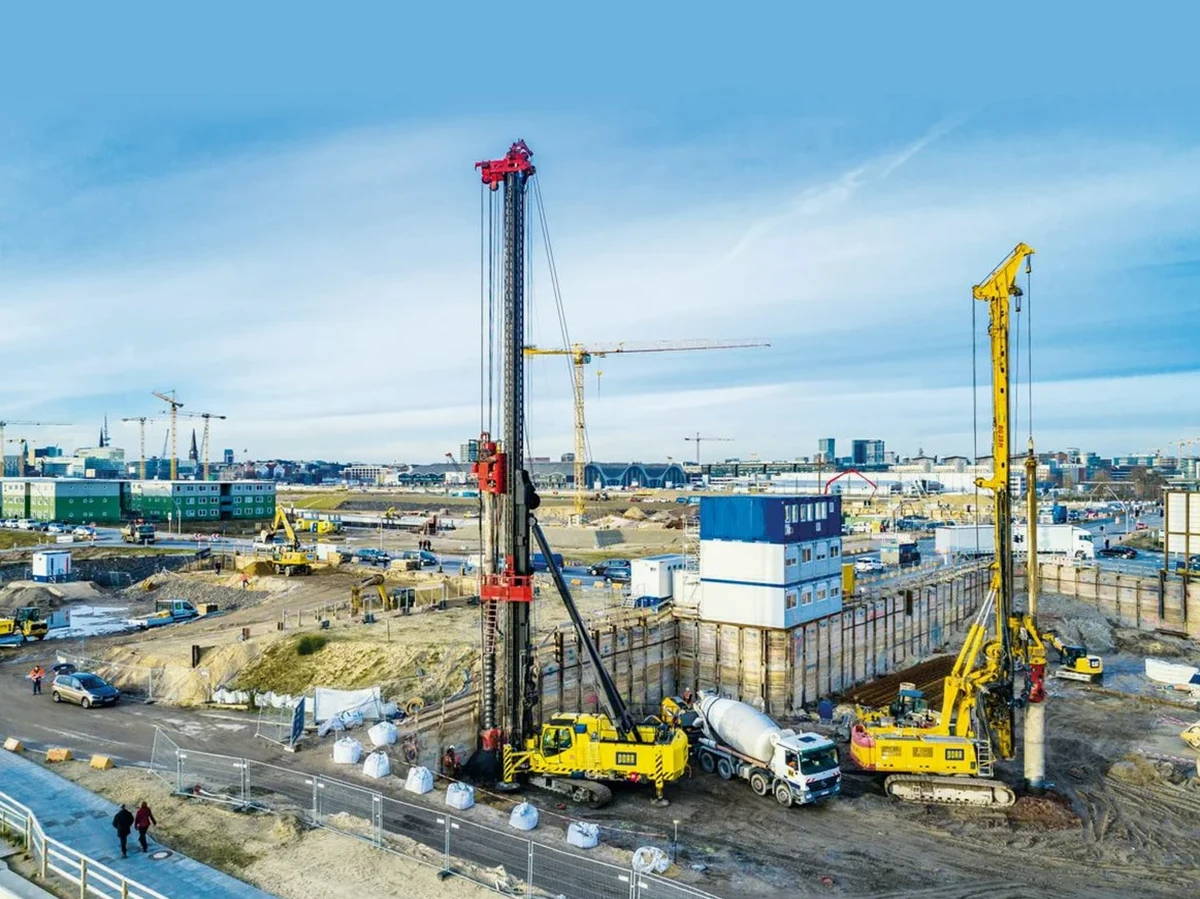
Concord sits at roughly 23 meters above sea level across a broad alluvial plain that drains toward Suisun Bay, and that low-relief setting masks a subsurface reality of interbedded clays, silts, and loose sands that challenge shallow bearing. Since the 2014 South Napa earthquake—a Mw 6.0 event just 30 kilometers away—owners and structural engineers in Concord have sharpened their focus on deep foundation performance under cyclic loading. Pile foundation design here must reconcile high seismicity with soil profiles where liquefiable layers appear within the upper 12 meters. We approach every Concord project with site-specific SPT drilling data tied directly to IBC Chapter 18 and the Caltrans geotechnical manual, so that axial and lateral pile capacities reflect actual stratigraphy rather than regional defaults. Where compressible clays dominate, we also evaluate settlement-sensitive structures using mat foundation alternatives before committing to a deep solution—because in Concord, the right fix depends on the soil column, not just the structural load.
In Concord's alluvial setting, pile design is controlled more by the depth to liquefiable sand and the stiffness of the clay crust than by structural gravity loads alone.
Relevant standards
ASCE 7-22 Minimum Design Loads and Associated Criteria for Buildings and Other Structures, IBC 2021 Chapter 18 Soils and Foundations, ASTM D1586-18 Standard Test Method for Standard Penetration Test (SPT) and Split-Barrel Sampling of Soils, ASTM D2487-17 Standard Practice for Classification of Soils for Engineering Purposes, Caltrans Geotechnical Manual, Deep Foundations, FHWA-NHI-16-009 Drilled Shafts: Construction Procedures and LRFD Design Methods
Common questions
What is the typical cost range for pile foundation design on a Concord commercial project?
For a mid-size commercial building in Concord, the geotechnical design package—including site investigation, laboratory testing, and pile foundation design—typically falls between US$1,920 and US$7,060. The spread depends on the number of borings, the complexity of the soil profile, and whether lateral load analyses with LPILE are required.
How do Concord's soil conditions affect pile depth compared to other Bay Area cities?
Concord sits on a deeper alluvial package than many East Bay hillside cities. Competent bearing—dense gravel or stiff clay with SPT N-values above 35—commonly lies between 16 and 24 meters. Shallower piles can work where the old alluvium rises, but in the central downtown corridor near Todos Santos Plaza, liquefiable sand layers often push pile tips past 20 meters to reach grade-supported strata.
Do Concord building departments require dynamic testing during pile installation?
The City of Concord adopts the California Building Code with local amendments. For larger structures, the building official typically requires at least one static load test or PDA (Pile Driving Analyzer) test per pile type. We coordinate with the contractor and the special inspection lab to have the test protocol and acceptance criteria ready before mobilization.