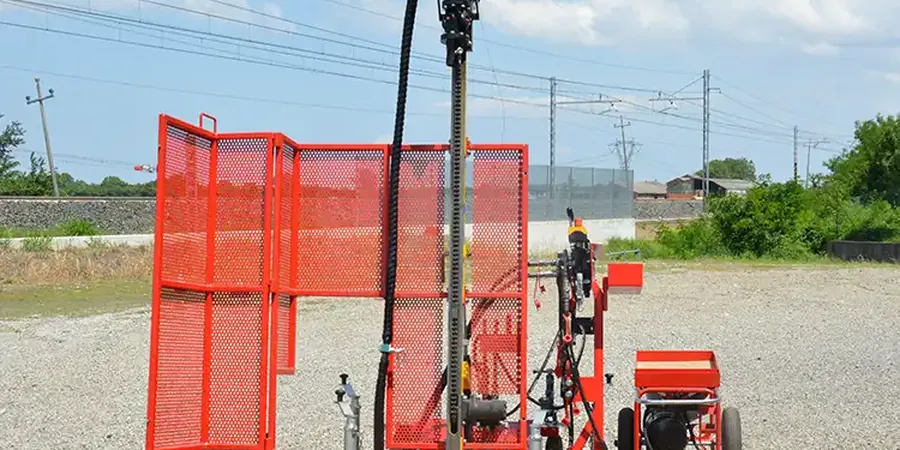
A three-story mixed-use project on Willow Pass Road hit an unexpected layer of loose sand at 18 feet during preliminary excavation. The structural engineer had designed for medium-dense soil based on older area maps, but the actual conditions told a different story. That discrepancy cost the developer six weeks of redesign and a foundation switch from spread footings to deep piles. This is precisely why the Standard Penetration Test remains the backbone of subsurface investigation in Contra Costa County. Our field crew runs SPT borings across Concord’s flatlands and hillside parcels, delivering N-value logs that let engineers correlate blow counts directly with bearing capacity, relative density, and seismic behavior. For sites near the Concord Fault or within the liquefaction-susceptible zones mapped by the California Geological Survey, the SPT provides the baseline data that feeds into liquefaction triggering analysis and site-specific ground motion studies without guesswork.
An N-value without the hammer energy ratio is just a number. We log everything needed for defensible N60 corrections.
Local ground factors
The most common mistake we see in Concord is contractors skipping deep borings on flat lots that look unremarkable from the surface. The valley fill across central Concord contains discontinuous lenses of soft clay and loose silt that don't show up on USGS quadrangle maps. A single shallow test pit won't catch a 3-foot-thick weak layer at 25 feet, but an SPT boring will — and that layer can double the predicted settlement under a mat foundation. Another recurring issue involves liquefaction screening. Sites west of the Concord Fault, particularly near the industrial corridor along Monument Boulevard, sit on Holocene-age deposits that the CGS Seismic Hazard Zone maps flag as liquefiable. Without SPT-based fines content and blow count data, a project can sail through permitting with an overly optimistic site class, only to face retrofit demands after plan check catches the omission. The IBC requires Site Class D assumptions unless site-specific data proves otherwise; our borings provide the N-values that justify a Site Class C upgrade when the ground supports it.
Common questions
How much does an SPT boring program cost in Concord?
For a typical residential investigation with two borings to 30 feet, the cost ranges from US$480 to US$760 per boring depending on access conditions, traffic control requirements, and whether we're drilling through fill or native material. Commercial programs with deeper borings and more holes scale accordingly, and we provide a fixed-price quote after reviewing the site address and project plans.
How deep do SPT borings need to go for a two-story building in Concord?
The rule of thumb for spread footings is a minimum boring depth of 1.5 times the foundation width below the bearing elevation, but in Concord's alluvial soils we typically go to 30 feet to capture any soft layers that could cause differential settlement. If the structure is on the west side of town near the liquefaction zones mapped by the CGS, borings often extend to 50 feet to evaluate the full thickness of potentially liquefiable Holocene deposits.
What's the difference between SPT and CPT testing?
SPT uses a split-spoon sampler driven by a hammer to recover a disturbed soil sample and measure blow counts, giving you both a strength index and a physical sample for lab classification. CPT pushes a cone continuously into the ground and measures tip resistance and sleeve friction without recovering a sample. The SPT is better when you need to see and classify the soil directly; CPT gives you a continuous profile and is faster in soft soils. Many Concord projects use SPT for sampling and CPT for filling in stratigraphic detail between boreholes.
How quickly can I get SPT results after field work?
Field logs with raw N-values and soil descriptions are available the same day the rig leaves the site. The final geotechnical report with N60 corrections, bearing capacity recommendations, and seismic site classification typically takes five to seven business days, assuming lab testing for grain-size distribution and Atterberg limits runs concurrently with report preparation.