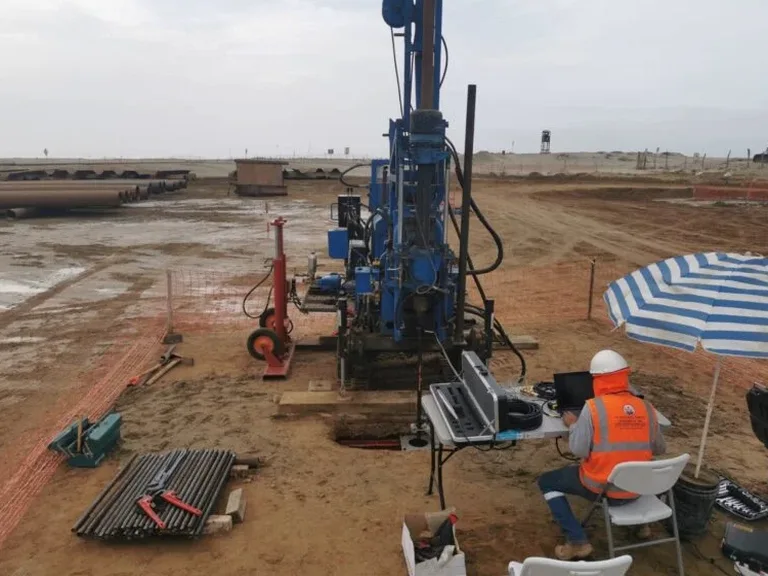
Concord sits at about 75 feet above sea level, but what matters more is what lies beneath. The 2014 South Napa quake was a wake-up call for all of Contra Costa County. We saw liquefaction damage in unexpected places, and since then, the demand for precise subsurface data has grown. The CPT test gives us a continuous soil profile without the disturbance of traditional sampling. We push a cone into the ground at a constant rate and read tip resistance, sleeve friction, and pore pressure in real time. For sites near the Concord Fault or in the older alluvial deposits around Monument Boulevard, this data is critical. It helps us correlate directly with liquefaction potential and refine bearing capacity estimates before anyone digs a footing.
A cone doesn't guess. It measures tip stress, sleeve friction, and pore pressure every 2 centimeters. That's a 50-readings-per-meter reality check for your foundation design.
Local ground factors
Concord's growth from an agricultural town to a major East Bay suburb meant rapid development on varied terrain. The old floodplains near Willow Pass Road and the deeper alluvial fans toward Clayton present different risks. We've seen buildings with differential settlement because the foundation design assumed uniform soil. CPT profiles from our work in the Monument Corridor show layers of soft Bay Mud trapped under stiffer crust you'd never detect with a hand auger. The biggest risk in our area? Unmapped, saturated loose sand lenses during a seismic event. The NCEER method, which uses CPT tip resistance and grain size estimates from friction ratio, gives us a direct liquefaction factor of safety. When we see an FS below 1.2 at a depth of 15 feet, we flag it. That flag changes the design from shallow footings to ground improvement, and it saves a building from a bad day when the Hayward Fault decides to move.
Common questions
What does a CPT test cost for a typical Concord residential lot?
For a single-family home site in Concord, a standard CPTu sounding to 50 feet typically runs between US$180 and US$290 per test location, including the mobilization, raw data, and basic SBT classification log. If you need seismic CPT (SCPTu) or multiple soundings across a larger parcel, the cost per test drops but the total scope increases. We provide a fixed-price proposal after reviewing the site address and depth requirements.
How does CPT compare to SPT for liquefaction analysis?
CPT gives us a continuous profile, while SPT samples every 2.5 or 5 feet. For liquefaction triggering, the NCEER method uses CPT tip resistance normalized for overburden (qc1N), and the friction ratio helps estimate fines content. It's more repeatable than SPT blow counts because there's no operator variability with hammer energy. When we suspect thin silt seams controlling the liquefaction response, we prefer CPT every time.
Can you push through gravel or hardpan in Concord?
Concord has areas with cemented gravel and hard clay layers. Our 20-ton rig handles most of what we encounter. If we hit refusal, we record the depth and tip resistance at refusal. In some cases, we pre-drill a few feet through the hard crust to get the cone into the softer material below, though this adds a step. We'll let you know if the site conditions warrant it during the initial walkthrough.
What is the turnaround time for CPT data and reports?
Raw digital logs are available at the end of the testing day. For a full geotechnical report with SBTn classification, liquefaction analysis, and bearing capacity estimates, you can expect 5 to 7 business days for a standard Concord lot. Larger commercial projects with multiple soundings and SCPTu data may take up to two weeks to process and interpret.