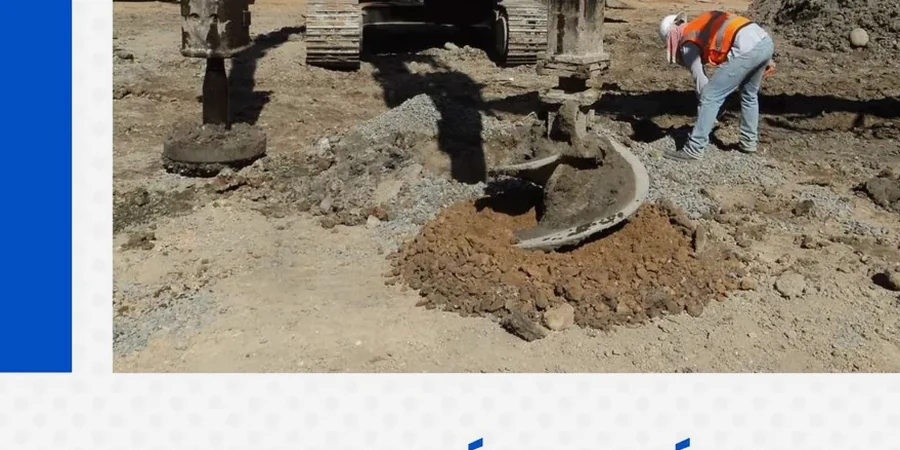
Too many contractors in Concord treat stone columns like generic gravel piles and wonder why the fill settles unevenly two years later. The clay and loose alluvium under this part of Contra Costa County do not respond to textbook spacing charts designed for clean sands. Our design team sees the same mistake on infill projects near Monument Boulevard: columns placed too far apart, no transition zone beneath the footings, and no verification against the site-specific groundwater level that fluctuates with the dry-wet cycle. A proper stone column design starts with the fines content from the grain-size analysis, not the column diameter alone. When the clay fraction exceeds fifteen percent, radial drainage slows and the load-settlement curve shifts. We size the stone and adjust the area replacement ratio to match the actual compressibility measured in the upper twelve feet, where most differential movement begins.
Column spacing that ignores the clay fraction is the most expensive shortcut in Concord ground improvement.
Local ground factors
A bottom-feed vibrator rig moves onto the site, and within minutes the operator hits a layer of desiccated crust that refuses to penetrate at the expected amperage. That crust, common across Concord's summer-dry surface soils, tricks the installation log into showing refusal on material that is actually just stiff from suction, not dense. The design must anticipate this by specifying pre-wetting or a reduced penetration rate for the upper five feet, otherwise the installed column stops short and leaves a soft pocket right where footing stresses peak. Without a liquefaction assessment tied to the NCEER simplified procedure, the column spacing near the water table might look adequate for static loads but fail to limit excess pore pressure during a Hayward Fault event. We require pore-pressure dissipation checks when the groundwater is within fifteen feet of the column tip, and we compare the treated-ground CSR against the cyclic resistance of the stone using the Seed-Idriss correlation.
Common questions
What does stone column design cost for a typical Concord commercial lot?
Engineering fees for a stone column design package on a half-acre commercial parcel in Concord range from $1,360 to $4,860 depending on the number of column groups, the depth of the soft layer, and whether seismic deformation screening is required. The fee covers the settlement analysis, the bearing-capacity checks, the column layout drawings, and the QA/QC specification package.
How do you verify the columns perform as designed?
Post-installation verification uses CPT soundings driven through the center of selected columns and at the midpoint between columns. We compare the measured tip resistance and sleeve friction against the design profile. For critical structures we add a zone load test with settlement plates to confirm the composite modulus under sustained load.
Can stone columns replace deep foundations in Concord's Bay Mud areas?
In many cases yes, provided the soft layer is less than thirty feet thick and the structural loads are moderate. The columns transfer stress through the mud to the stiffer alluvium below, reducing total settlement below the one-inch threshold that typically triggers deep foundations. We run a side-by-side cost comparison with driven piles to confirm the benefit.
How close to existing structures can you install stone columns?
With a bottom-feed vibrator we can install columns as close as five feet from an existing footing, using low-amplitude starts and monitoring ground vibrations with a seismograph. In tighter spaces the dry top-feed method with an excavator-mounted probe works within three feet of a property line.