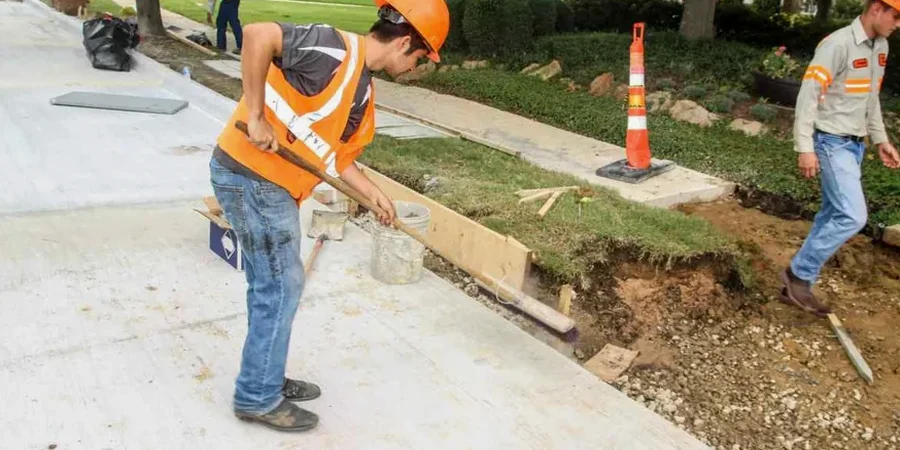
A logistics hub in the North Concord industrial corridor was losing a forklift pallet a week to cracked asphalt. The DC manager called it quits after the third patch in six months. We ran the numbers on a jointed plain concrete pavement alternative using actual CBR values from on-site borings, not county averages. The switch to rigid pavement cut maintenance downtime by eighty percent in the first year. Concrete isn’t cheap upfront, but when your subgrade is fat clay that swells with winter rain and shrinks come August, asphalt becomes a recurring liability. The CBR road test we ran on the insitu clay gave us a modulus of reaction that made the PCA thickness design straightforward and defensible for the owner’s budget.
A rigid pavement doesn’t just spread load—it spans soft subgrade. In Concord’s expansive clay, that distinction saves thousands in subgrade remediation.
How we work
Concord sits on the western edge of the Central Valley alluvial plain, with large pockets of lean and fat clay mapped as Clear Lake and Capay series by the USDA. Plasticity indices above 25 are common in the Monument Boulevard corridor. That subgrade demands a rigid pavement section that separates structural capacity from soil volume change. We design jointed plain concrete pavement (JPCP) with doweled contraction joints at spacing calibrated to slab thickness and climate—Concord’s summer highs hit 100°F regularly, so curling stress is real. AASHTO 93 methodology drives the initial thickness, but we validate it with PCA’s finite element output for edge loading at joints. Key parameters we lock early: flexural strength of the concrete mix (typically 600–650 psi at 28 days), modulus of subgrade reaction from plate load tests, and the 30-year ESAL projection. For heavy truck yards, we often step up to a 7-inch slab with a cement-treated base over a geotextile separation layer to stop fines migration. The result is a pavement that bridges weak spots rather than deflecting into them.
Local ground factors
AASHTO 93’s reliability concept is explicit: a 90% design reliability for urban arterial concrete pavements carries a standard normal deviate of -1.282, meaning the owner accepts a 10% probability that the pavement reaches terminal serviceability before the design period ends. In Concord, skipping the plate load test and using a textbook k-value for clay is the fastest way to eat that 10%. We’ve seen slabs 1.5 inches thinner than required when designers assume a stiff subgrade that isn’t there. Fatigue cracking at transverse joints shows up within five years, and the repair is full-panel replacement—disruptive and costly. Faulting is another risk. Without dowels sized per AASHTO for the traffic category, adjacent slabs step vertically under heavy truck braking, creating a ride-quality failure that triggers liability for the owner. And in Concord’s industrial parks where truck traffic is channelized, the erosion of the base layer under repeated edge loading can pump fines out at joints, undermining the slab. We specify non-erodible bases and positive drainage to intercept runoff before it reaches the subbase.
Relevant standards
AASHTO 1993 Guide for Design of Pavement Structures, PCA EB204P: Thickness Design for Concrete Highway and Street Pavements, ASTM C78: Flexural Strength of Concrete (Modulus of Rupture), ASTM D1196: Nonrepetitive Static Plate Load Tests of Soils for k-value, Caltrans Standard Specifications, Section 40: Portland Cement Concrete Pavement
Common questions
When does rigid pavement make more sense than asphalt in Concord?
Concrete wins when subgrade CBR is below 4, when truck traffic is channelized (loading docks, bus stops), and when the owner calculates net present value over 20+ years. Concord’s expansive clay punishes flexible pavement with fatigue cracking and rutting; rigid pavement bridges that problem and shifts the maintenance burden to joints, which are predictable and repairable.
What’s the typical slab thickness for a heavy truck yard in Contra Costa County?
For 5 million ESALs over 30 years on a CH clay subgrade with a 4 in. cement-treated base, a 7.5 to 8.0 in. JPCP section is common. The exact number comes from the AASHTO equation once we have the k-value from a plate load test. Guessing without that test can leave you an inch thin.
What does a rigid pavement design package cost for a Concord project?
Design fees range from US$1,620 for a small private lot with one soil unit and simple joint layout, to US$7,200 for a municipal collector street with multiple subgrade transitions, ESAL analysis from traffic counts, and full StreetPave fatigue modeling. The fee includes the site investigation, lab testing for concrete mix validation, and the stamped design report.
Do you use dowel bars in all rigid pavement designs?
We specify doweled transverse contraction joints per AASHTO for any pavement carrying more than one million ESALs or truck traffic over 10% of ADT. Dowels transfer shear across the joint and prevent faulting. For low-volume residential streets, aggregate interlock alone can work if slab lengths are kept short.
How long before a new concrete pavement can handle construction traffic?
Under Concord summer temperatures, a 7-inch slab with Type II cement reaches 2,400 psi compressive in about 4 days—enough for light pickup trucks. We recommend 7 days before allowing loaded concrete mixer trucks on the slab, and 14 days before full heavy truck operations. Flexural strength, not compressive, governs the opening criteria.