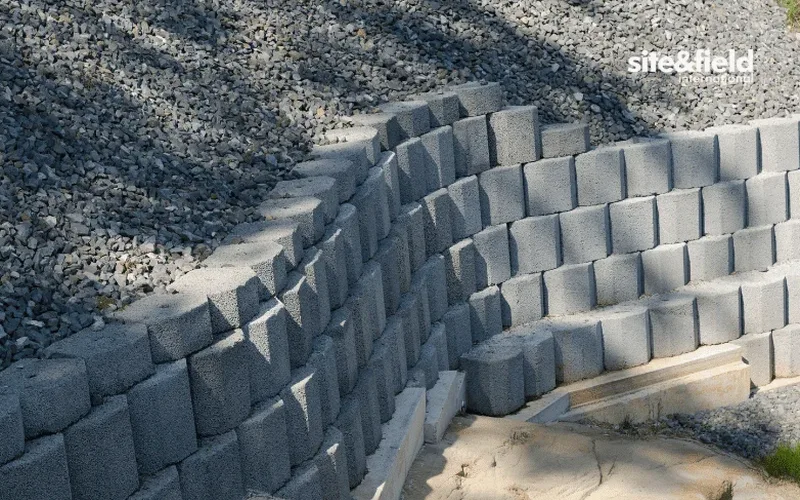
Concord sits in a geotechnical transition zone — the flatlands near Highway 4 are underlain by deep alluvial clay, while the slopes rising toward Lime Ridge and Mount Diablo expose weathered sandstone and shale. This juxtaposition creates retaining wall design scenarios that demand two very different analytical approaches within the same city. The clay basin soils exhibit moderate to high expansion potential, with swell pressures that can exceed 3,000 psf if moisture content is not controlled. On the hillside lots, shallow bedrock complicates excavation but provides excellent bearing for gravity and cantilever walls. We routinely combine site-specific borings with laboratory swell testing to define the active zone depth, because a retaining wall in Concord is rarely a standalone element — it interacts with foundations, drainage, and uphill development. For walls exceeding six feet in height, the IBC triggers review under Chapter 18, and we typically pair retaining wall analysis with a slope stability assessment when the wall is located mid-slope or supports a cut deeper than four feet.
A retaining wall in Concord's expansive clay is only as reliable as the drainage system behind it — we design for the water you cannot see.
Local ground factors
A small excavator opens a bench cut behind a Concord hillside home, exposing chocolate-brown clay with a glossy, striated surface. The operator shuts down the machine and the crew notices a hairline crack propagating parallel to the cut face, about three feet back from the edge. That crack is a classic warning sign — the overconsolidated clay is relieving lateral stress faster than the temporary shoring can handle. On this particular project near the Concord Pavilion, the cut was only eight feet high but the upper four feet consisted of fill placed in the 1960s, loose and laced with old tree roots. Our field engineer logged the exposure, measured the crack opening, and recommended immediate placement of a granular buttress at the toe while the permanent anchored wall design was finalized. The lesson is simple: in Concord, temporary cuts in clay-fill interfaces deserve the same respect as the permanent wall. A shallow-seated failure during construction can undermine the footing of the wall you are about to build, turning a straightforward retaining wall design into a costly slope repair. We document the cut condition with photographs and hand penetrometer readings before the first cubic yard of structural backfill arrives.
Common questions
How much does a retaining wall design cost in Concord?
For a typical Concord residential or commercial retaining wall, the geotechnical investigation and structural design package ranges from US$930 to US$4,490. The final cost depends on wall height, number of borings required, and whether a slope stability analysis is mandated by the city's grading ordinance. Shorter walls under 6 feet with simple site conditions fall at the lower end; walls over 10 feet with tiebacks and seismic analysis reach the higher end.
What is the minimum wall height that requires a permit in Concord?
The City of Concord generally requires a building permit for retaining walls exceeding 4 feet in height measured from the bottom of the footing to the top of the wall, or for any wall supporting a surcharge such as a driveway or structure. Walls under 4 feet may still require a grading permit if they are part of a larger earthwork operation. We always recommend checking with the Community Development Department for the current ordinance.
How do you handle expansive clay behind a retaining wall in Concord?
We address expansive clay through a combination of moisture control and material substitution. The design includes a minimum 12-inch-wide zone of non-expansive granular backfill directly behind the wall, a continuous subdrain at the base, and a low-permeability cap at the surface to limit infiltration. The structural design accounts for an at-rest earth pressure condition plus an additional swell pressure increment determined from laboratory consolidation-swell tests on undisturbed samples.
Do all retaining walls in Concord need seismic analysis?
Yes, per ASCE 7-22 and the IBC, retaining walls in Concord must include a seismic earth pressure increment in the design load combination. The city is assigned a Site Class D profile with a short-period spectral acceleration of approximately 0.30g. For walls over 6 feet, we perform a Mononobe-Okabe analysis to compute the total active earth pressure under seismic conditions. Walls under 6 feet with low consequence may use a simplified pseudo-static coefficient, but seismic loading is never omitted entirely.