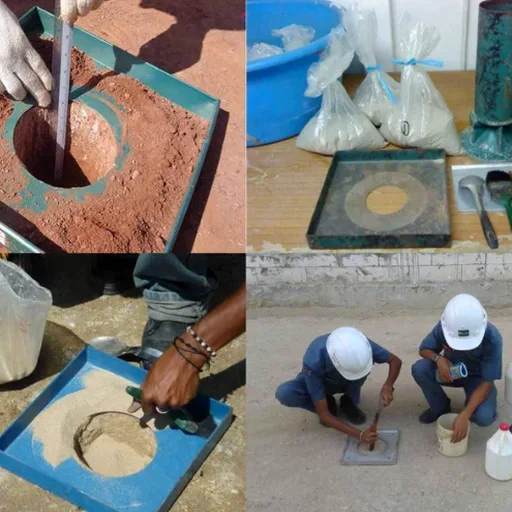
The warm, dry summers that define Concord's Mediterranean climate create a narrow window for achieving optimal moisture content during earthwork. Too often, contractors in the East Bay find that material compacted in the morning has lost critical moisture by the 2 p.m. heat, skewing the field density results. This is precisely why the sand cone method remains the go-to field verification tool here — it gives us a direct, physical measurement of in-place density that speaks honestly about what the compactor actually achieved, not what the theoretical lab curve predicted. Our work across Concord, from subdivisions near the sun-baked slopes of Mount Diablo to commercial pads along Willow Pass Road, consistently shows that without rigorous on-site density checks, the delta between lab and field performance widens dangerously. We pair this with Proctor testing to establish the reference curve, ensuring the numbers we read from the sand cone correlate to a standard that matches the specific borrow source being used on site.
A passing sand cone test doesn't just confirm a number — it validates that the compactor, moisture, and lift thickness worked together as a system under real field conditions.
Local ground factors
In our experience on Concord projects, the most frequent failure mode isn't the test itself but what happens the day after: a passing density report that doesn't hold up once the fill sees the first winter rains. The clay-rich soils from the local alluvial fans can undergo significant swelling if they were compacted dry-of-optimum, passing the density check but sealing in a moisture deficit that later causes heave beneath floor slabs. We've also encountered sites near the Concord Naval Weapons Station redevelopment area where undocumented trench backfills from the Cold War era were simply pushed into place without any density control. When a new footing straddles the interface between competent native soil and these old, uncompacted fills, differential settlement is almost guaranteed. The sand cone method, performed at the right frequency and with careful moisture monitoring, gives the geotechnical engineer the data to flag these risk zones before concrete is poured, making it a far cheaper intervention than forensic settlement analysis after the fact.
Relevant standards
ASTM D1556-15e1: Standard Test Method for Density of Soil in Place by the Sand-Cone Method, ASTM D698-12e2: Standard Test Methods for Moisture-Density Relations (Standard Proctor), ASTM D1557-12e1: Standard Test Methods for Moisture-Density Relations (Modified Proctor), ASTM D2216-19: Standard Test Methods for Laboratory Determination of Water Content, Caltrans Standard Specifications Section 19-5: Earthwork Compaction Control, IBC 2021 Section 1804: Excavation, Grading, and Fill
Common questions
What does a field density test with the sand cone method cost in Concord?
A single sand cone test in the Concord area typically ranges from US$90 to US$160 per point, depending on the number of tests scheduled in a day, travel distance to the site, and whether companion Proctor curves need to be developed from your borrow source. A full-day mobilization with 6-8 tests and a laboratory Proctor is generally the most cost-efficient structure for medium-sized earthwork jobs.
How does the sand cone method compare to a nuclear density gauge for Concord's soils?
The sand cone measures density directly by volume displacement, which avoids the calibration drift and licensing requirements of a nuclear gauge. In Concord's clayey fills, where the iron and boron content in the native soils can skew nuclear readings, ASTM D1556 often provides a more defensible result, especially when the test will be reviewed by a city inspector or a third-party geotechnical consultant.
How many sand cone tests are required per lift?
The industry standard — and what most Concord building officials expect to see — is a minimum of one field density test per 2,500 square feet of lift area, or approximately one test per 150 cubic yards of compacted fill, whichever yields a higher testing frequency. Trench backfills under pavement typically require a test every 100 linear feet per lift, and the lower lifts in deep fills often get tested at double frequency because they are the hardest to rework if they fail later.
What soil types are unsuitable for the sand cone test?
ASTM D1556 is not recommended for soils with a maximum particle size exceeding roughly 1.5 inches, because a single large gravel can distort the hole volume measurement. For open-graded aggregates or crushed rock bases common under Concord's commercial parking lots, we typically recommend a water replacement method or a calibrated large-scale field density test instead, and we can advise on the right alternative during the pre-construction meeting.