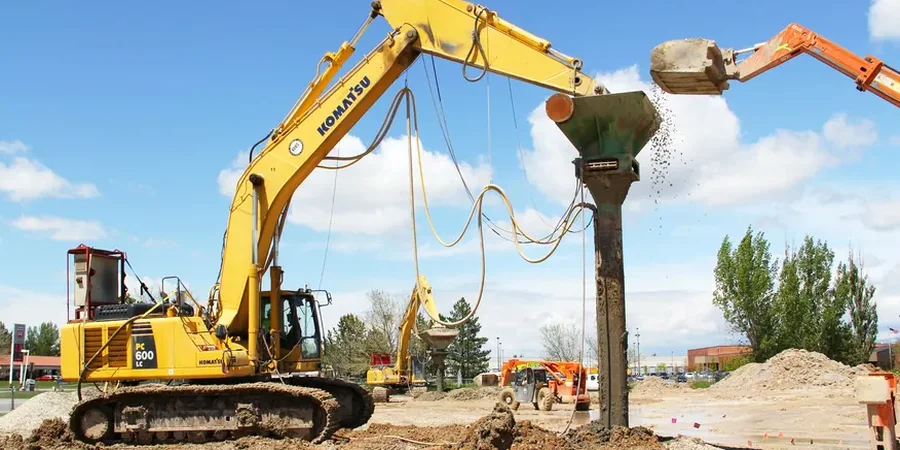
Concord sits on a complex alluvial plain where the Sacramento-San Joaquin Delta transitions into the Diablo Range foothills. Much of the city center is underlain by loose to medium-dense sands and silty sands from Pleistocene terrace deposits, with groundwater often found within 15 to 25 feet of the surface. The 2014 South Napa earthquake, which shook Concord at Modified Mercalli Intensity VI, was a stark reminder that unconsolidated granular soils are vulnerable to settlement and liquefaction. Our vibrocompaction design work in Concord targets relative density above 70% to shut down that risk before construction starts. We combine this with a grain-size analysis to confirm the fines content stays below the 15% threshold where vibratory methods lose efficiency, and we cross-reference the results with SPT drilling data to correlate blow counts with post-improvement density targets across the site.
Moving a site from ASCE 7 Site Class D to Site Class C through vibrocompaction can cut seismic base shear demand by 15-25% — that's a direct structural savings.
Local ground factors
Concord's growth after World War II pushed residential subdivisions eastward into the Ygnacio Valley, where artificial fill and young alluvial soils dominate. Many structures built before the 1997 Uniform Building Code seismic provisions, and certainly before the current IBC 2024 requirements, lack any ground improvement beneath their footings. Liquefaction-induced settlement of 2 to 4 inches is plausible in a M6.7 event on the Concord-Green Valley Fault, based on Seed-Idriss simplified procedure using NCEER (2001) corrections. That magnitude of differential movement tears apart slabs, severs utility lines, and racks steel moment frames beyond their drift limits. A properly designed vibrocompaction program, executed with real-time digital recording of amperage and depth on every probe point, eliminates the guesswork. The client receives a post-treatment report with before-and-after SPT logs and GPS-located probe sheets that satisfy the special inspection requirements of IBC Chapter 17.
Common questions
How much does vibrocompaction design cost for a typical Concord commercial lot?
Our design fees for a standard commercial lot in Concord (0.5 to 2 acres) range from US$1,270 to US$5,490, depending on the number of probe points, depth of treatment, and whether we manage the verification drilling. This covers the feasibility review, grid design, performance specification, and post-treatment report. The actual field compaction work by the specialty contractor is a separate cost we can help you estimate during the design phase.
What soil conditions in Concord make vibrocompaction effective?
The method works best in clean to slightly silty sands with less than 15% passing the #200 sieve. Much of Concord's alluvial deposits east of Highway 242 fit this profile. If the fines content is higher, we typically recommend stone columns or deep soil mixing instead. We always run a grain-size analysis first to confirm suitability before specifying the grid.
How long does a vibrocompaction treatment take on a 1-acre site?
A typical 1-acre site with probe depths to 30 feet and 7-foot triangular spacing requires about 4 to 7 working days of field time, depending on the rig's productivity and any access constraints. The design work takes 2 to 3 weeks, and verification drilling adds another 2 to 3 days after the compaction is complete.
What verification do you provide that the ground improvement actually worked?
We perform SPT or CPT borings at pre-selected verification locations after treatment, typically one test per 2,000 to 3,000 square feet. The results are statistically compared against the pre-treatment baseline to confirm the target N1(60) or tip resistance values are met. The final report includes GPS-located logs, statistical tables, and a signed statement of compliance with IBC Chapter 18 acceptance criteria.