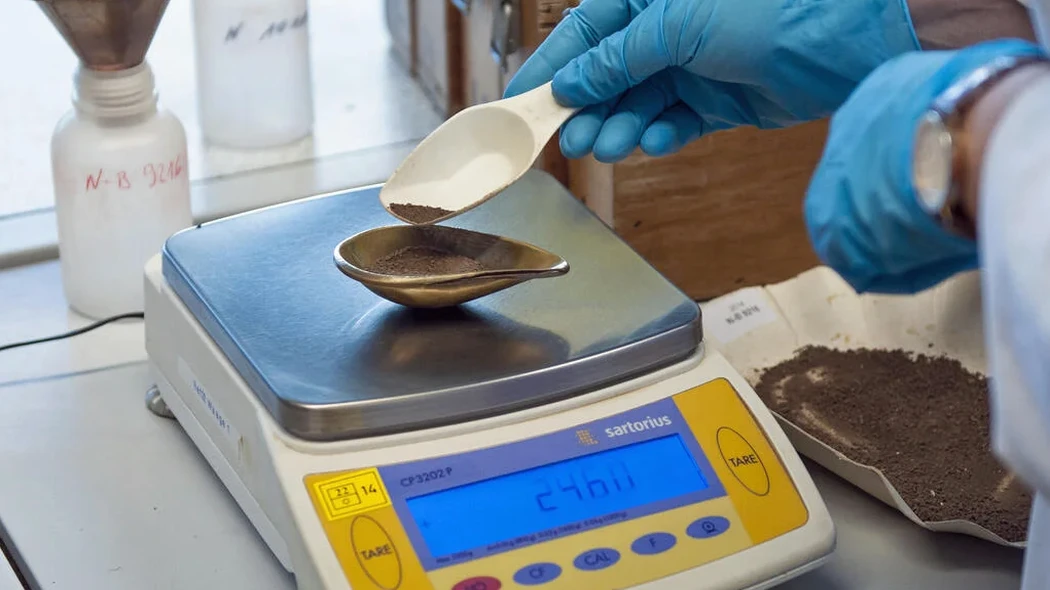
The soil profile changes fast when you cross from the Todos Santos Plaza side over toward the Lime Ridge Open Space. Downtown Concord sits on younger alluvium with plenty of sand and gravel lenses, while the slopes pushing up against Mount Diablo carry weathered claystone and silty residuum that fines out below the #200 sieve in a hurry. A standard sieve-only pass misses half the story in those transitions. We run paired grain size analysis plus hydrometer on every split spoon recovered from Concord borings, combining ASTM D6913 dry sieving with D7928 sedimentation so the full curve from gravel to colloid is on the table before a single footing dimension gets locked in. When the clay fraction swings past 20 percent on a site that looked clean at the surface, the compaction spec and drainage assumptions shift with it—and that curve is what tells you whether your imported fill will pump under traffic or hold a crown through the rainy season. For coarser profiles near the Concord Naval Weapons Station redevelopment zone, we often run the sieve stack in parallel with SPT drilling so N-values and gradation come from the same drive, giving the geotechnical engineer a matched dataset for liquefaction screening per Youd-Idriss 2001 without extrapolating across different holes.
A gradation curve is the cheapest geotechnical insurance you can buy—when the D50 shifts, so does the permeability, the compaction window, and the liquefaction susceptibility.
Local ground factors
Concord sits at roughly 75 feet above sea level in the downtown core, but the real number that matters for gradation is the 80-plus inches of rain that can hit the Diablo foothills in a wet winter. Fine-grained soils that barely registered on a summer sieve test turn into near-liquid slurry when saturated, and if the gradation curve wasn't run with a hydrometer, the contractor never knew those silts were there. The 2014 South Napa earthquake—a M6.0 on the West Napa Fault, felt strongly across Concord—reminded every geotechnical engineer in the East Bay that silty sand layers with a high fines content can behave like contractive soils under cyclic loading even when the SPT blow count looks respectable. A complete grain size distribution with percent clay and silt pinned down lets us run the fines-corrected liquefaction triggering analysis that separates borderline material from truly competent bearing strata. Skip the hydrometer on a Concord site with interbedded clay seams, and the log calls a soil "silty sand" when it's actually a clayey silt that will hold pore pressure and lose strength during the next event on the Concord-Green Valley Fault system. That classification error propagates into the foundation design, and the fix is never cheap once the structure is up.
Common questions
How much does a grain size analysis (sieve + hydrometer) cost on a Concord project?
A combined ASTM D6913/D7928 analysis with wash, full sieve stack, and hydrometer typically runs between US$100 and US$210 per sample depending on the number of hydrometer readings required and whether the material needs extended dispersion time for high-clay soils. Bulk pricing applies when we process multiple samples from the same boring program.
When does the hydrometer test become necessary instead of just a sieve analysis?
The hydrometer is required whenever more than 5 to 10 percent of the sample passes the #200 sieve—which is common in Concord's alluvial and hillside residuum soils. Without it, you cannot determine the silt-versus-clay split, and the USCS classification remains incomplete. The CBC and ASTM D2487 both require the full fines fraction to be characterized for any soil where plasticity or drainage matters.
How long does it take to get results back from the lab?
A standard sieve-only turnaround is 2 to 3 working days. Adding the hydrometer extends the schedule by 24 to 48 hours because of the sedimentation reading intervals and oven-drying cycles. We can expedite to same-week delivery for most Concord projects when the samples arrive by Tuesday, and we email the preliminary curve ahead of the signed report for time-sensitive foundation decisions.
Which ASTM standards do you follow for gradation testing?
We follow ASTM D6913 for dry sieving of the coarse fraction, ASTM C117 for wash loss through #200, and ASTM D7928 for hydrometer sedimentation of the fine fraction. The combined data is classified under ASTM D2487 (Unified Soil Classification System). All work is performed under our ISO 17025-accredited laboratory scope, which the Contra Costa County Building Department and most Concord plan reviewers accept without additional validation.