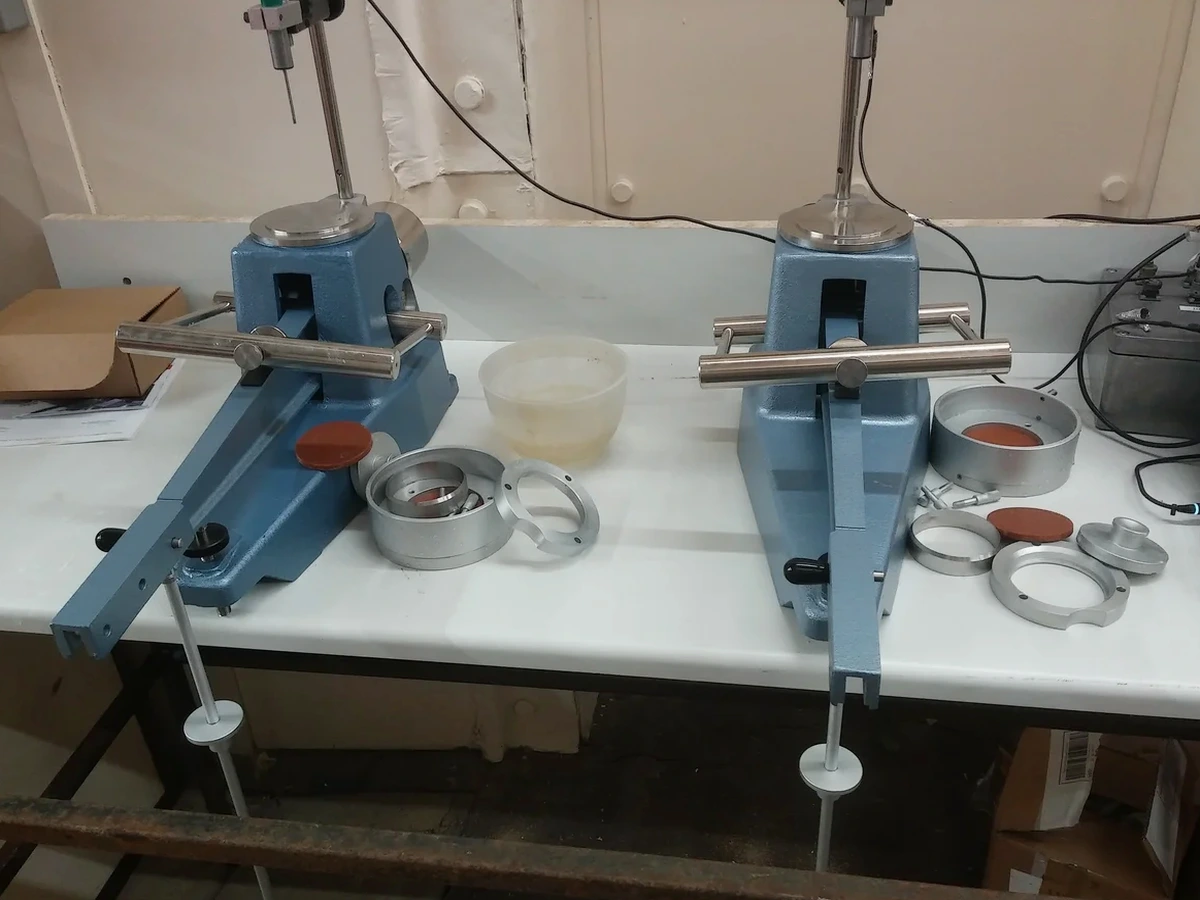
Contractors working near Todos Santos Plaza deal with stiff alluvial clays that crack during summer droughts. Meanwhile, crews by the Naval Weapons Station wetlands face silty clays that turn to slurry after a winter storm. Same city. Completely different soil behavior. Atterberg limits testing is how we quantify that difference before it becomes a change order. The liquid limit, plastic limit, and plasticity index tell you exactly how much water your soil can handle before it loses strength. ASTM D4318 defines the procedure. Our AASHTO-accredited lab in the East Bay runs it daily on materials from Concord clay lenses, Diablo foothill colluvium, and everything in between.
Atterberg limits are the cheapest early-warning system in geotechnical engineering. A $75 test can prevent a $50,000 foundation repair.
Local ground factors
Concord sits on a mix of Quaternary alluvial deposits and Franciscan Complex bedrock. The valley floor clays are notoriously expansive. A 2019 USGS map of the Concord quadrangle shows mapped clay units with moderate to high shrink-swell potential running right under the downtown corridor. Contractors who skip Atterberg testing on these units gamble with slab heave, cracked stem walls, and pavement undulation within two seasonal cycles. The plasticity index is the key metric. Anything above 25% signals a soil that needs engineering attention—moisture barriers, deeper footings, chemical stabilization, or granular replacement. The IBC Chapter 18 references expansive soil mitigation explicitly, and the Atterberg limits are the trigger test for those requirements.
Relevant standards
ASTM D4318-17e1: Standard Test Methods for Liquid Limit, Plastic Limit, and Plasticity Index of Soils, AASHTO T-89/T-90: Determining the Liquid Limit and Plastic Limit of Soils, ASTM D2487-17: Standard Practice for Classification of Soils for Engineering Purposes (Unified Soil Classification System), IBC 2024 Chapter 18: Soils and Foundations (expansive soil provisions)
Common questions
How much does Atterberg limits testing cost in Concord?
For projects in Concord, a full Atterberg suite (liquid limit, plastic limit, and plasticity index) typically runs between US$50 and US$110 per sample, depending on specimen preparation needs and whether a single-point or multi-point liquid limit is requested.
Which soils need Atterberg testing?
Fine-grained soils—silts and clays—with 50% or more passing the No. 200 sieve. Coarse sands and gravels do not exhibit plasticity and are not tested. The cutoff is determined by a preliminary sieve analysis.
What does a high plasticity index mean for my Concord building site?
A PI above 25% indicates expansive potential. Concord clays in the alluvial valley floor frequently fall in the 30–50% PI range, meaning they will shrink when dry and swell when wet. This can lift slabs, crack walls, and shift footings without proper mitigation like moisture conditioning or pier-and-beam design.
How long does the lab take to return Atterberg results?
Standard turnaround is 48 hours from sample receipt. Same-day expedited service is available for active earthwork operations needing real-time compaction or moisture decisions.