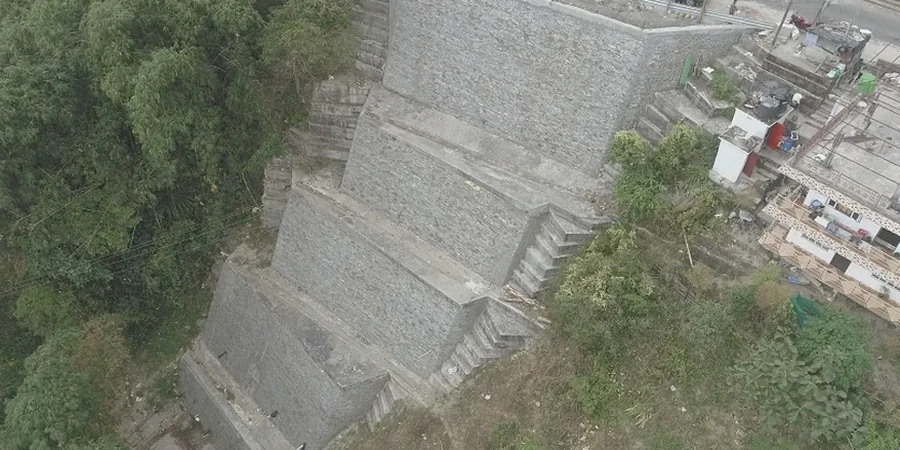
In Concord, the interaction between the Diablo Range foothills and the flat valley floor makes slope stability analysis a non-negotiable part of any project near open cuts or natural grades. We work under ASCE 7-22 Chapter 11 seismic criteria and California Building Code amendments, but what drives the analysis here is the Franciscan Complex bedrock—sheared, weathered, and often mantled with clay-rich colluvium. Our approach starts with subsurface characterization through test pits to map the residual soil profile, because standard borings alone miss the shallow failure surfaces we see repeatedly in this region. For projects backing up to Lime Ridge or the steeper terrain east of Clayton Road, the analysis must also account for transient pore pressure buildup during the rainy season, when saturation can reduce the factor of safety below 1.0 in slopes that appeared stable all summer.
A slope that drains well in August can fail in February if the analysis didn’t model the perched water table that forms in the colluvium after three weeks of rain.
Local ground factors
The 2023 USGS landslide inventory update mapped several dormant earthflow deposits along the Concord fault zone, particularly where the clay gouge from fault shearing creates a low-strength basal plane. What we see in practice is that slopes as gentle as 3H:1V can experience progressive creep when the toe is undercut for a cut-and-fill pad, and the failure develops over months rather than minutes. The Diablo clay family—expansive, smectite-rich—complicates this further: desiccation cracks in summer become preferential infiltration paths in winter, and the cyclic swelling-shrinking reduces near-surface shear strength to near-residual values. A common mistake is designing for peak strength parameters from a single exploration program conducted in September, when moisture content is at its annual minimum. We insist on wet-season pore pressure profiles and strength testing at natural water content plus saturation to bracket the realistic range.
Relevant standards
ASCE 7-22 Chapter 11 & 12 (Seismic Design Parameters for Concord), California Building Code 2022 Section 1807 (Foundation Walls and Retaining Structures), FHWA-NHI-11-032 (Evaluation of Soil and Rock Properties for Slope Design), ASTM D4767-11 (Consolidated-Undrained Triaxial Compression Test with Pore Pressure Measurement), ASTM D4318-17 (Atterberg Limits – Diablo Clay Characterization), USGS Landslide Hazard Program Guidelines (2019)
Common questions
What triggers a slope stability analysis requirement in Concord?
The City of Concord’s building department generally requires a slope stability report when grading exceeds 5 feet of cut or fill, when the natural slope is steeper than 5H:1V, or when construction is within 50 feet of a mapped landslide feature. The requirement stems from CBC Section 1808 and the city’s hillside ordinance, and the report must be stamped by a California-licensed geotechnical engineer.
How do you handle the Franciscan Complex variability in slope models?
We drill or excavate test pits at a spacing that captures the block-in-matrix fabric—typically 50 to 75 feet along the slope axis. Strength parameters are assigned probabilistically in the model, with separate material zones for the shale matrix and the sandstone blocks, because a single homogenized strength envelope overestimates stability. Where we find slickensided surfaces from past tectonic shearing, we run sensitivity analyses with residual friction angles as low as 8 degrees.
What is the typical cost range for a slope stability analysis for a single-family lot in Concord?
For a residential hillside lot in Concord, the slope stability analysis package—including subsurface exploration, laboratory testing, and the signed report—typically ranges from US$1,160 to US$4,650, depending on slope height, access constraints, and whether instrumentation like inclinometers or piezometers is required for long-term monitoring. A taller cut with poor access on the Diablo foothills will push toward the upper end of that range.
Can you use SPT data for slope stability analysis, or do you need undisturbed samples?
SPT data gives us blow counts for relative density and consistency, which is useful for preliminary screening, but for a defensible factor of safety we need undisturbed samples for triaxial or direct shear testing. Disturbed SPT samples lose the in-situ structure that controls drained strength in overconsolidated clays. We typically combine SPT borings for stratigraphy with thin-wall Shelby tubes at the critical failure surface depth to get both data sets economically.