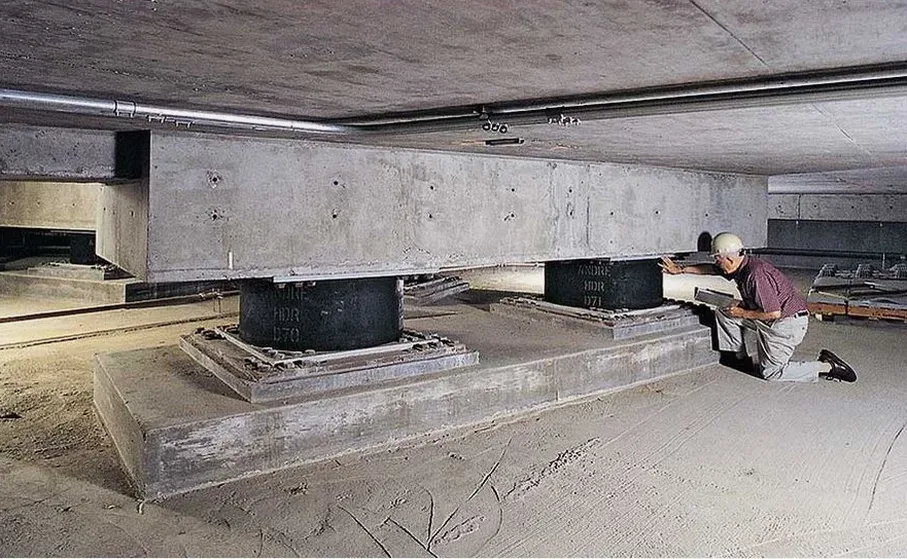
When a five-story medical office building near the Concord Pavilion required a solution to maintain functionality after a major Hayward Fault event, the structural team recognized that conventional fixed-base design would not meet the owner's resilience targets. Concord sits in a seismically complex basin where deep alluvial soils over bedrock can amplify long-period ground motion, making base isolation not merely an option but a strategic design decision. We provided the complete isolation system engineering package, from spectral matching of site-specific ground motions per ASCE 7-22 Chapter 17 to detailed modeling of lead-rubber and triple-pendulum bearing behavior under MCE_R shaking. The project incorporated nonlinear time-history analysis to verify displacement capacity across the isolator array while ensuring that the superstructure remained essentially elastic, a requirement that becomes particularly demanding when the isolation period must clear the 1.5-to-2.5-second range where basin resonance peaks in the Concord area. For projects requiring deeper soil characterization before isolator specification, we often coordinate with SPT drilling to establish shear wave velocity profiles that feed directly into the site response model.
In Concord's deep alluvial basin, shifting the structural period past 2.5 seconds through isolation cuts base shear by 60 to 75 percent compared to fixed-base design.
Local ground factors
Concord's 2020 population of approximately 125,000 resides in a zone where the USGS seismic hazard model assigns a 10-percent-in-50-year probability of peak ground acceleration exceeding 0.5g, driven by contributions from the Hayward Fault eight miles to the west and the Concord-Green Valley Fault system directly beneath the city. The 2014 South Napa earthquake, though centered 25 miles away, produced recorded ground motions in Concord that exceeded 0.2g at periods relevant to mid-rise buildings, offering a real-world preview of how basin-edge effects can extend shaking duration well beyond what uniform-hazard spectra predict. Base isolation addresses the primary risk that standard code-compliant design leaves unmitigated: the accumulation of structural and nonstructural damage across repeated moderate events that, individually, do not exceed design levels but collectively degrade the building's lateral system over decades. By decoupling the structure from ground motion, isolation protects not only the primary frame but also acceleration-sensitive contents—medical equipment, data centers, and manufacturing lines—whose replacement cost and downtime often exceed the structural repair bill by an order of magnitude.
Relevant standards
ASCE/SEI 7-22 Minimum Design Loads and Associated Criteria for Buildings and Other Structures, Chapter 17, IBC 2024 International Building Code, Section 1705.13 (special inspection of seismic isolation), FEMA P-1051 NEHRP Recommended Seismic Provisions for Seismically Isolated Buildings, AASHTO Guide Specifications for Seismic Isolation Design (applicable to bridge projects in Concord)
Common questions
What is the typical cost range for base isolation design on a Concord commercial building project?
For a mid-rise commercial or institutional building in the Concord area, the engineering design package for the isolation system generally falls between US$4,120 and US$9,360, depending on the complexity of the superstructure, the number of isolators, and whether nonlinear response-history analysis is required instead of the simpler equivalent lateral force procedure. This scope covers spectral matching of ground motions, isolator specification and modeling, prototype test plan preparation, and coordination with the structural engineer of record. The isolator hardware itself is a separate procurement item supplied by the bearing manufacturer.
Does ASCE 7-22 require prototype testing for every base isolation project?
Yes. ASCE 7-22 Section 17.8 mandates prototype testing for all seismic isolation systems unless the project qualifies for a very narrow exemption based on prior test data from identical bearing designs. The standard requires at least two full-size isolators to be tested under a loading protocol that includes three fully reversed cycles at each displacement increment up to the maximum considered earthquake displacement, plus wind and thermal cycling. The test results establish the upper- and lower-bound property modification factors used in the bounding analysis, which is non-negotiable for Concord projects where isolator behavior must be validated across the expected range of aging and environmental effects.
How does base isolation affect the foundation design for a Concord site with soft soils?
Base isolation concentrates lateral demand at the isolation plane, which means the foundation system must be designed for the full base shear transmitted through the isolators—typically much lower than fixed-base base shear but applied with significant axial load variation due to overturning. On Concord's Site Class D and E soils, we often specify a rigid mat foundation beneath the isolators to enforce uniform displacement across the array and prevent differential settlement from compromising isolator levelness. The geotechnical investigation must characterize soil stiffness down to at least 100 feet for site response analysis, and the moat wall retaining system must be designed for the MCE_R displacement plus an allowance for torsion.
Can base isolation be retrofitted to an existing building in Concord?
Yes, though it is technically demanding and typically reserved for essential facilities or historic structures where continued operation after an earthquake is mandatory. The retrofit process involves temporarily supporting the building on jacking columns, cutting the existing columns at a common horizontal plane, installing isolators, and constructing a new moat wall and utility connections with sufficient flexibility to accommodate the isolation displacement. For Concord buildings with basement levels, the isolation plane is often placed at the top of the basement walls, which requires careful detailing of the diaphragm to transfer seismic forces to the isolators. A detailed structural audit and geotechnical reassessment are prerequisites before a retrofit design can proceed.