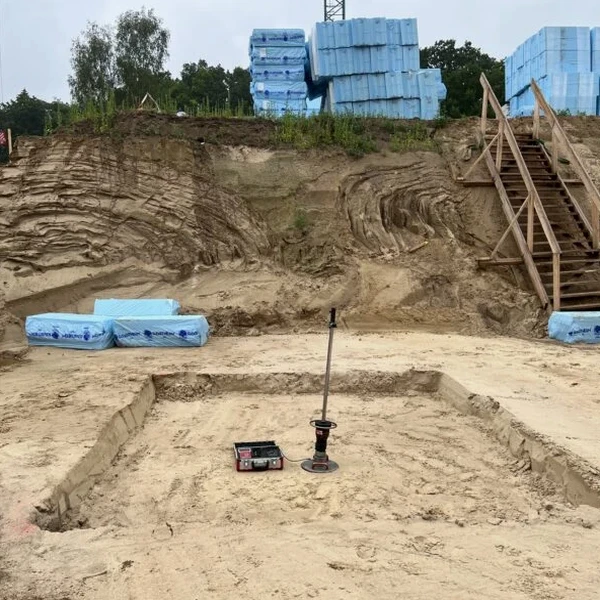
The mechanical rammer hits the mold 25 times per lift on a gravelly clay from the Ygnacio Valley, and the reading on the scale starts to stabilize. That is the moment a Proctor test transitions from a lab procedure to a construction permit requirement in Concord. The city’s building department, following CBC Chapter 18 and ASTM D698, will not sign off on compaction without a valid curve linking moisture to density. Concord sits on alluvial fans and hillside residuum derived from the Franciscan Complex, which means natural soils vary from expansive clays near Monument Boulevard to sandy silts closer to the Delta. A single standard Proctor value borrowed from a project across town is technically irrelevant. Each site needs its own maximum dry density and optimum moisture content, determined under controlled conditions in a soils lab. For deeper lifts or heavy traffic loads, the modified Proctor per ASTM D1557 applies a higher compactive effort that better simulates modern vibratory rollers. This data feeds directly into field density acceptance using a sand cone density test, closing the loop between lab specification and field verification.
A Proctor number without a matching soil description and compaction method is just a number—it tells you nothing about how the fill will perform under Concord’s wet winters and dry summers.
How we work
Concord sits at roughly 23 meters above sea level, but the geotechnical conversation here is not about elevation—it is about the Diablo Foothills colluvium and the compressible clays in the low-lying tracts near Highway 4. These materials react very differently to moisture, and a Proctor curve generated with the wrong method leads to rejection of lifts during field inspection. The standard Proctor (ASTM D698, Method A through C) uses a 5.5-pound hammer dropped 12 inches, generating 12,400 ft-lbf/ft³ of compactive effort. The modified Proctor (ASTM D1557) uses a 10-pound hammer dropped 18 inches, delivering 56,000 ft-lbf/ft³—more than four times the energy. In Concord, standard effort is typical for residential slabs and landscape berms, while modified effort governs engineered fill under commercial buildings, retaining walls, and roadway subbase. A complete report includes the moisture-density curve, zero air voids curve, and the specification window (±2% of optimum moisture, typically 90–95% relative compaction). The lab performs a one-point Proctor check for field verification when material changes are suspected during grading. Supplemental
Atterberg limits testing helps classify the fines fraction and predict how the soil will behave when moisture fluctuates seasonally.
Local ground factors
The most preventable failure on a Concord grading project happens when the contractor runs a Proctor on one borrow source, then switches to a different pit halfway through without re-testing. Soil from the northern side of the site might be a low-plasticity sandy lean clay, while material from fifty yards south is a fat clay with double the optimum moisture. The inspector checks field density against the original curve, the numbers do not line up, and the lift gets rejected—costing a day of rework. Another common mistake is using the standard Proctor for fill that will support a heavily loaded slab or a segmental block wall over 4 feet high. The City of Concord typically requires modified Proctor for structural fill under footings and pavements in commercial subdivisions. Failing to account for oversize particles also skews results; ASTM D4718 correction must be applied when more than 5% of the material is retained on the No. 4 sieve. A proper Proctor program, coordinated with the project geotechnical engineer, prevents these disputes before the first truckload of fill arrives.
Common questions
What is the difference between standard and modified Proctor tests?
The standard Proctor (ASTM D698) applies 12,400 ft-lbf/ft³ of compactive energy using a 5.5-pound hammer dropped 12 inches. The modified Proctor (ASTM D1557) applies 56,000 ft-lbf/ft³ using a 10-pound hammer dropped 18 inches. Modified effort produces higher maximum dry density and lower optimum moisture content, simulating heavier rollers used on commercial and roadway projects in Concord.
When does the City of Concord require a modified Proctor instead of standard?
The Concord building department typically specifies modified Proctor for structural fill supporting commercial foundations, retaining walls over 4 feet, public roadway subgrade, and any engineered fill where the geotechnical report calls for 95% relative compaction based on ASTM D1557. Residential landscaping and shallow utility trenches often use standard effort.
How much does a Proctor test cost in Concord?
A standard or modified Proctor test in the Concord area generally ranges from US$110 to US$220 per sample, depending on whether the material requires the 4-inch or 6-inch mold and whether oversize corrections per ASTM D4718 are needed. Turnaround is typically 2 to 3 working days.
How is optimum moisture content used during field compaction?
Optimum moisture content is the water content at which the soil achieves maximum dry density under the specified compactive effort. In the field, the contractor adjusts water—adding or aerating—to stay within ±2% of optimum before compaction. Field density is then checked against the Proctor curve using a nuclear gauge or sand cone method.
What happens if the soil contains gravel or cobbles larger than the mold size?
ASTM D4718 provides a correction procedure for oversize particles retained on the No. 4 or 3/4-inch sieve. The laboratory scalps the coarse fraction, runs the Proctor on the fine fraction, then mathematically corrects the density and water content. Without this correction, the reported maximum dry density would be artificially low and field compaction targets would be incorrect.